
Stafford Projected vs Actual Release
A projected date is a calculation, not a record that someone walked out. Kansas correctional records may show several dates because the state has more than one sentencing structure. A determinate guidelines sentence can carry an anticipated release calculation. An older indeterminate sentence may instead show parole eligibility, conditional release, or maximum expiration. Each label answers a different question. Parole eligibility means the person may be considered for release. Conditional release and sentence expiration arise from other statutory calculations. None should be renamed as an actual Stafford County release date.
Pretrial custody works differently. A person held on a pending Stafford County case has no sentence from which to compute a firm date. Bond may be posted, the judge may change release terms, charges may be dismissed, or another agency may lodge a hold. The Stafford County Sheriff’s record identifies the physical departure and its disposition. A court docket explains the order behind it. If the disposition says transfer to KDOC, another jail, BOP, or ICE, the person left Stafford custody but did not necessarily return to the community.
Find a Stafford Projected Release Date
Start with the custody system, not with a date calculator. The Stafford County Sheriff documents local detention. The Stafford County District Court holds the judgment, sentence, and jail-credit order. The Kansas Department of Corrections holds state-prison computations. Mixing those sources is the fastest way to produce a false date. The full released-person lookup and local records path also appear on the Stafford County released inmates search.
- Identify the custodian. Ask whether the person is in Stafford local custody, another county, or KDOC. “Not here” is not proof of release.
- Check the court case. Use the Kansas District Court Public Access Portal for the Stafford case. Read the judgment, sentence, jail-credit finding, later modifications, and any probation or revocation entries.
- Use KASPER for state custody. Accept the KASPER disclaimer, search by KDOC number when possible, and match identifiers before reading release-related fields.
- Keep the exact label. Record “Anticipated Guidelines Release Date,” parole eligibility, conditional release, or expiration exactly as displayed. Do not collapse them into one promise.
- Confirm after the date. Recheck the status after KDOC’s next working-day update, or ask the jail, facility, or supervising office for direct confirmation.
A KASPER result is not a complete Kansas criminal history. A person whose only event was a Stafford arrest and bond release may not appear. Names and aliases also collide, while some fields vary by sentence history. For a local sentence, contact the Sheriff at the official office rather than applying a state-prison formula. For older or disputed court details, the courthouse’s public terminal may provide accessible documents that are unavailable remotely.
Kansas Credits Shape Stafford Release Dates
Kansas does not have one universal “serve 85 percent” rule. Under K.S.A. 21-6821, many guidelines crimes have a good-time ceiling of 15 percent of the prison portion. That ceiling produces the familiar 85-percent shorthand. The same law allows a 20-percent ceiling for specified crime dates and severity levels, and it provides separate program-credit authority in defined cases. The offense date, sentence type, severity level, eligibility, conduct, and completed programs all matter.
Good time is earned and can be withheld or lost. It is not a discount that a reader can safely subtract from a headline term. For some determinate cases, credit that shortens the prison portion is added to postrelease supervision. The person may leave the prison gate sooner yet remain under KDOC control. An actual status of parole, conditional release, or postrelease supervision therefore means release from confinement, not final discharge from the sentence.
Jail-time credit is another calculation. K.S.A. 21-6615 directs the sentencing judge to account for qualifying time already spent in custody or specified confinement and to designate the computation date in the judgment. The signed Stafford County journal entry is the starting proof. KDOC applies that order to a state sentence. The Sheriff should not be asked to rewrite the judge’s credit finding.
No Stafford Jail Credit Formula
Stafford County did not publish a local jail good-time policy in the reviewed official sources. No county-specific weekend or holiday early-release rule was found either. That absence matters. KDOC’s 15- and 20-percent ceilings govern covered state sentences, not every short sentence served through the Stafford County Sheriff’s detention function.
For a county sentence, compare the sentencing order with the court’s jail-credit entry, then ask the Sheriff for the recorded release event. If the ordered term seems inconsistent with the date, request the existing booking/release sheet and the relevant court documents. Do not ask the agency to create a new legal calculation. A narrow records request is more useful: identify the person and admission, seek the recorded date and disposition, and ask for an estimate before fees are incurred.
This distinction is Stafford’s most important release-date safeguard. A statewide formula copied onto a local sentence can be wrong even when the arithmetic is flawless. The controlling records come from the judge and physical custodian.
Why Stafford Release Dates Change
A displayed date reflects the facts and law known to the custodian at that point. Later conduct, a corrected judgment, another case, or a different release decision can change the result. A date can also pass while the person remains confined because another authority has a valid hold.
| Factor | Effect on the date or destination | Best confirmation |
|---|---|---|
| Good-time award or loss | Changes the credited portion of a covered KDOC prison term. | KASPER status and KDOC computation record |
| Program credit | May change a qualifying calculation under statutory limits. | KDOC sentence record |
| Jail-time credit | Credits qualifying prior confinement as ordered by the sentencing judge. | Stafford journal entry and KDOC calculation |
| Court modification or revocation | Can alter the sentence, return a probationer to custody, or create a new controlling order. | District-court docket and signed order |
| Detainer or transfer | May end custody in one place without release to the community. | Releasing record and receiving agency |
| Parole decision | Eligibility does not guarantee release; a Board decision may grant, pass, or continue review. | Prisoner Review Board record and later KASPER status |
Older indeterminate sentences add another layer. The Kansas Prisoner Review Board distinguishes eligibility from suitability. A person may reach an eligibility point and still receive a pass or continued consideration rather than parole. Conditional release is governed by a separate maximum-term calculation. For guidelines cases, the prison period is generally computed rather than granted through the same discretionary process.
Read Stafford KASPER Dates Precisely
KASPER stands for Kansas Adult Supervised Population Electronic Repository. It follows KDOC involvement across facilities and supervision, which makes it more durable than a county roster. Search controls include last, first, and middle name, aliases, KDOC number, photo options, and advanced identifying filters. A detail record can include status, facility or supervision information, sentence entries, and more than one release-related date. Not every record contains every field.
- Anticipated Guidelines Release Date
- KDOC’s named forward-looking field for a determinate guidelines sentence when it applies.
- Parole eligibility
- The point at which an eligible indeterminate-sentence person may be considered, not a guaranteed exit date.
- Conditional release
- A statutory release point tied to the applicable maximum calculation and credits.
- Postrelease supervision
- A community-supervision period that can begin after the prison portion ends.
- Discharge
- The end of the applicable correctional or supervision obligation, distinct from prison release.
The repository states that it updates each working day. A same-day movement can lag. It also warns that community-corrections probation events after April 21, 2021 cannot display during modernization. That gap is relevant to Stafford cases handled by Central Kansas Community Corrections. Current probation must be verified with the court and agency, not inferred from an old KASPER entry.
The official KASPER screen shows the disclaimer and search route used for Stafford state release-date checks.
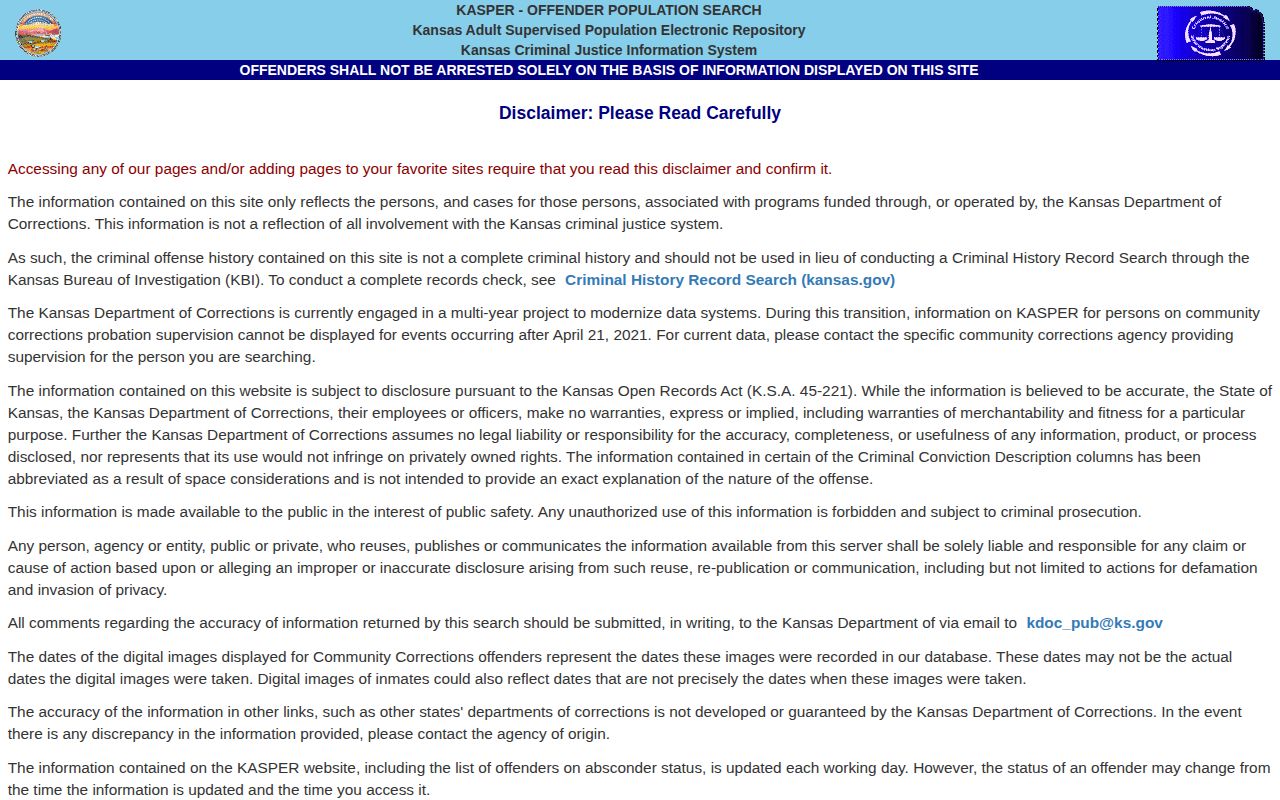
That warning is why the displayed label, access date, and later status all belong in a careful release-date check.
When a KASPER field appears wrong, use the repository’s correction route at kdoc_pub@ks.gov and identify the exact field. A county booking error goes to the Stafford custodian instead. A court judgment issue belongs with the court process.
Confirm a Stafford County Release
Use the agency that actually holds the person. For local custody, the Stafford County Sheriff’s Office is at 209 N. Broadway, St. John, Kansas 67576, with nonemergency phone (620) 549-3247. Ask whether the person remains held. If not, ask for the recorded release date, time, disposition, and destination. Published office hours are 8:00 a.m. to 5:00 p.m. Monday through Friday, while the county KORA policy lists records processing through 4:00 p.m.
For a state prisoner, recheck KASPER after its working-day update and contact the current facility or KDOC record channel when immediate proof matters. A status of postrelease supervision can be verified through KDOC Community & Field Services. The Hutchinson Parole Office serves Stafford County under the published directory. A final discharge requires a later KDOC record or certificate, not merely the anticipated prison date.
Kansas VINE is not the state-prison date tool. The Attorney General describes it as covering adults in county jails while excluding KDOC prison offenders. It can still provide a local custody-change alert when the Stafford record participates. The Stafford VINELink check explains that county/state split. After any alert, obtain the releasing agency’s record because a transfer and community release are not the same event.
For documentary local proof, send a narrow Kansas Open Records Act request for the existing booking/release sheet. K.S.A. 45-218 requires action by the end of the third business day, but “acted on” does not guarantee production by then. Ask for electronic delivery, a cost estimate, and the separable public portions if any material must be redacted.
Keep a verification log with the exact date label, access date, displayed status, and office contacted. When sources disagree, the signed order governs the sentence, the physical custodian records the movement, and KDOC maintains the state calculation. None should be silently rewritten to match another system.
Note: A passed projected date is not proof of release; confirm the later status and the destination with the responsible custodian.